Introduction

SECTION ONE: INTRODUCTION

Welcome to the State of Hawaii Procurement Wizard (Procurement Manual). The Procurement Wizard is the official guide to the procurement process for goods, services, and construction. The State’s primary procurement resources include the Procurement Wizard, Hawaii Revised Statutes (HRS), and the Hawaii Administrative Rules (HAR).

1.1 UPDATES

The Procurement Wizard is updated to reflect the specific revisions provided in a Procurement Circular. The Procurement Wizard is maintained in accordance with the State of Hawaii’s record retention requirements. Relevant Procurement Circulars have been incorporated into the Procurement Wizard. Revision History will be maintained as part of the Procurement Wizard.

1.2 PURPOSE AND APPLICATION

To aid the State’s Procurement personnel, the Procurement Wizard describes standard procedures and sound business practices that implement statutory requirements regarding purchasing Executive Branch goods, services and construction and health and human services.

The Procurement Wizard demonstrates the ongoing commitment of the State Procurement Office (SPO) to standardize state procurement practices and procedures by:

  • Establishing best practices to clarify the law governing procurement in the State of Hawaii;
  • Providing for the continued development of standardized procurement policies and practices;
  • Ensuring consistency in procurement practices among Executive Branch agencies;
  • Providing for increased transparency and public confidence in the procurement procedures followed by Hawaii governmental agencies;
  • Ensuring the fair and equal treatment of everyone who deals with Hawaii procurement processes and systems;
  • Providing increased economy in state procurement activities by maximizing the purchasing value of public funds and obtaining the commodities and services required by governmental agencies in a cost-effective and responsive manner;
  • Fostering effective, broad-based competition in the marketplace; and
  • Maintaining ethics, quality and integrity in Hawaii public procurement.

In addition to detailing procurement processes and practices, the Procurement Wizard presents a roadmap of the procurement process to guide agencies from start to finish through the various stages of the full procurement lifecycle.

The guidance provided in this document governs all Executive Branch agencies subject to the Chief Procurement Officer’s authority pursuant to HRS 103D-203, unless specifically exempted by statute.

Other statutory Chief Procurement Officer jurisdictions governed by Hawaii statutes, but not subject to the authority of the Administrator of the State Procurement Office, are encouraged to leverage this guide as a best practice.

The Wizard does not refer to every section and paragraph of the Hawaii procurement statutes and rules. It is a general guide. When procuring, please ensure the relevant statutes and regulations are also reviewed. Resources tabs are located at the top of each section page.

1.3 Procurement Fundamentals

1.3.1 What is Procurement?

“Procurement” means buying, purchasing, renting, leasing, or otherwise acquiring any good, service, or construction.  The term also includes all functions that pertain to the obtaining of any good, service, or construction, including description of requirements, selection and solicitation of sources, preparation and award of contracts, and all phases of contract administration, HRS 103D-104. Ultimately, it is the act of putting the people’s money to work in a way that upholds the people’s trust.

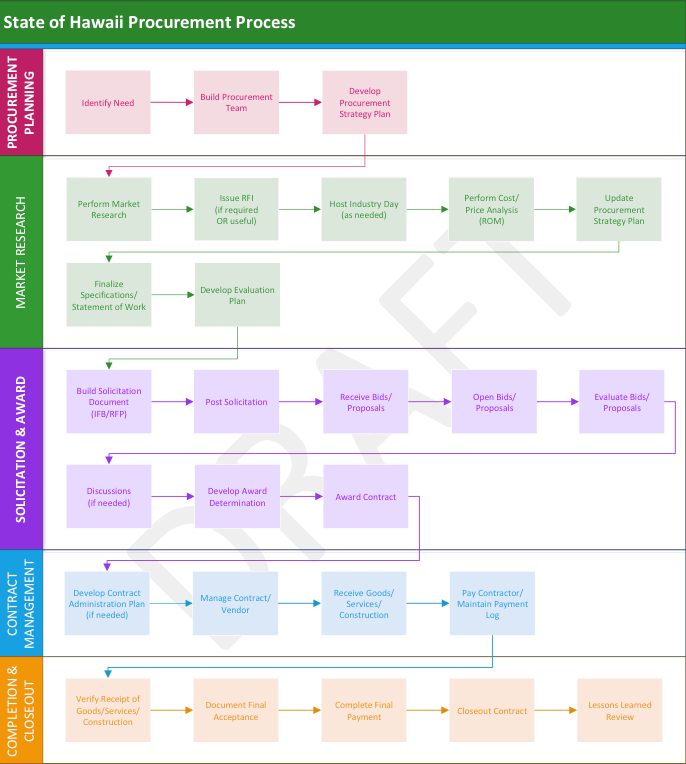
The Hawaii Procurement Lifecycle, illustrated below, organizes the procurement process into a series of steps from the time the state entity first identifies a needed good, service, or construction through contract award, contract administration and contract closeout.

The Hawaii Procurement Lifecycle

Procurement Lifecyle

1.3.2 Hawaii’s Procurement Structure

Public procurement in the State of Hawaii is primarily authorized and governed by HRS 103D, HRS 103F and HAR Title 3. Additional authority and guidance for procurement in the State of Hawaii reside in the following sources. Note the list below is not exhaustive and procurement personnel are advised to include any agency specific requirements and/or applicable State, Federal and other law

Hawaii Revised Statutes (HRS)

  • Chapter 103D – Hawaii Public Procurement Code
  • Chapter 103F – Purchases of Health and Human Services
  • Chapter 103 – Expenditure of Public Money and Public Contracts
  • Chapter 103B – Construction Procurement Contracts
  • Chapter 92F – Uniform Information Practices Act
  • Chapter 84 – Standards of Conduct
  • Chapter 104 – Wages and Hours of Employees on Public Works

Hawaii Administrative Rules (HAR)

  • HAR Title 3 – Department of Accounting and General Services

Other Sources of Procurement Guidance include, but are not limited to:

Procurement authority for the Executive Branch agencies in Hawaii is conveyed by statute to the Administrator of the State Procurement Office (SPO) through HRS 103D-203(a)(8). In accordance with HRS 103D-208, the Administrator, as Chief Procurement Officer (CPO) for the Executive Branch, may further delegate the authority to procure goods, services, and construction, with restrictions, to designees, including, but not limited to, executive department heads within the CPO’s jurisdiction.  HRS 103D-203 establishes twenty-one CPO jurisdictions for the following state agencies:

  1. The judiciary–the administrative director of the courts;
  2. The senate–the president of the senate;
  3. The house of representatives–the speaker of the house of representatives;
  4. The office of Hawaiian affairs–the chairperson of the board;
  5. The University of Hawaii–the president of the University of Hawaii; provided that, except as specified in section 304A-2672(2), for contracts for construction and professional services furnished by licensees under chapter 464, the administrator of the state procurement office of the department of accounting and general services shall serve as the Chief Procurement Officer;
  6. The department of education, excluding the Hawaii public library system–the superintendent of education;
  7. The Hawaii health systems corporation–the chief executive officer of the Hawaii health systems corporation; and
  8. The remaining departments of the executive branch of the State and all governmental bodies administratively attached to them–the administrator of the state procurement office of the department of accounting and general services.

The Chief Procurement Officers for each of the several counties are:

  1. The executive branch–the respective finance directors of the several counties, except as provided in paragraphs (3), (4), and (5);
  2. The legislative branch–the respective chairpersons of the councils of the several counties;
  3. The Honolulu, Kauai, and Maui boards or departments of water supply–the managers and chief engineers of the respective boards or departments of water supply as designated by county charter;
  4. The Hawaii board of water supply–the manager of the board of water supply as designated by county charter; and
  5. The semi-autonomous public transit agency–the director of the agency as designated by county charter.

In the Wizard, generally references to the CPO means the Administrator of the State Procurement Office in the capacity as CPO for the Executive Branch unless otherwise indicated.

In accordance with HRS 103D-104, “Procurement officer” means any person authorized to enter into and administer contracts and make written determinations with respect thereto.  The term also includes an authorized representative acting within the limits of authority.

1.3.3  Ethical and Professional Conduct

State of Hawaii personnel involved in the procurement of goods, services, and construction have the responsibility to uphold Hawaii procurement laws and act in good faith to serve the best interests of the State of Hawaii and its taxpayers.

The Code of Ethics for public officers and state employees in the conduct of procurement activities is detailed in HRS 103D-101(a) and further detailed in HAR 3-131-1.02, with penalties for violation prescribed in HRS 103D-106 and HAR 3-131-4. All public officers and state employees, not just procurement professionals, are expected to read and understand these key statutes prescribing proper conduct.

HRS 103D-101(a) states:

“All public employees shall conduct and participate in public procurement in an ethical manner. In conducting and participating in procurement, public employees shall:

  • Act as a fiduciary and trustee of public moneys;
  • Remain independent from any actual or prospective bidder, offeror, contractor, or business;
  • Act only in the public interest;
  • Abide by the statutes and administrative rules relating to public procurement;
  • Identify and maximize efficiencies in the public procurement process;
  • Encourage economic competition by ensuring that all persons are afforded an equal opportunity to compete in a fair and open environment and researching innovative goods and services to meet the public’s needs;
  • Avoid the intent and appearance of unethical behavior;
  • Avoid social interactions with any actual or prospective bidder, offeror, contractor, business, or other interested parties during the procurement process;
  • Maintain confidentiality in a manner that ensures a fair procurement process;
  • Remain impartial in dealings with any actual or prospective bidder, offeror, contractor, business, or other interested parties; and
  • Identify and eliminate any conflicts of interest.”

Specific requirements applicable to all persons engaged in the procurement process are detailed in HAR 3-131-1.02, Procurement Code of Ethics. The provisions found in HAR 131 set forth the minimum requirements for ethical procurement, proscribe specific actions, such as parceling or “after-the-fact procurements” and set forth penalties for failure to comply.

In addition, all State of Hawaii public officers and employees are governed by the State of Hawaii Code of Ethics as enforced by the State Ethics Commission. The laws setting out the Code of Ethics are contained in HRS 84.

1.3.4  What is a Contract?

A legally enforceable agreement, or contract, consists of the following elements:

  1. OFFER: A willingness to enter into a contract based on certain terms. When a state agency receives acceptable bids or proposals as part of a procurement, these qualify as an offer.
  2. ACCEPTANCE: A willingness to be bound by the terms and conditions of the offer. This includes the terms and conditions set forth in the procurement issued by a state agency that have become part of the offer, plus additions such as pricing and delivery terms. The State award of a contract would qualify as acceptance.
  3. CONSIDERATION: Anything of value promised to another in exchange for fulfillment of the offer. Typically, the state promises money in exchange for goods, services, or construction.
  4. LAWFUL PURPOSE: A valid contract must have a legal purpose. For example, a “contract” to murder someone would be not be enforceable in court.
  5. CAPACITY: A party to a contract must have the ability to enter into a legal contract. In general, there are three classes of persons that lack capacity to be bound by contractual promises – minors, intoxicated persons and mentally incompetent persons.

1.3.5  Procurement Training and Delegation of Authority

In accordance with HRS 103D-206, the State Procurement Office has implemented a training and development program to ensure that agency personnel involved in the procurement process are knowledgeable of the laws, regulations, and policies that govern public procurement in Hawaii.

Prior to engaging in any procurement activities agency personnel are required to receive training and obtain delegation of authority to procure by the Head of the Purchasing Agency (HOPA). Agency personnel that are directly involved in the development of a solicitation, the execution of a procurement action, or the management of an ensuing contract are required to complete the appropriate training. Details of mandatory and recommended workshops are provided in the Procurement Training Requirements Table located on the SPO website.

Most training is provided in an on-demand format to ensure agency personnel are able to access the training they require in a timely manner. Training workshops can be accessed from the ‘Training’ resources tab of each section and on the SPO On-Demand Training page on the SPO website.

1.3.6  Procurement Forms

Throughout the Procurement Wizard, various forms are referenced for use in the procurement process specifically by the Executive Branch. SPO maintains a list of forms needed to conduct and document a procurement on the Forms tab of the SPO website. Additionally, the website maintains the latest version of each form and should be accessed before initiating a new procurement to ensure that the most current form is used and to avoid a disruption in the process. Forms may be located in the Templates tab of each section.

1.4 Hawaii Procurement Lifecycle

The organization of the Procurement Wizard is based on the Hawaii Procurement Lifecycle, outlined below, with individual sections dedicated to each of the five stages of the lifecycle.

Procurement Life Cyle Detail

Each Section in the Wizard begins with a Key Information subsection that provides a general overview of the tasks associated with that lifecycle phase and provides links to tools and templates identified in the section. Following this overview, each section provides guidance and direction on how to properly execute the tasks associated with that phase of the lifecycle and continue workflow through the remaining phases.

All references to purchases of Health and Human Services will be highlighted throughout this manual.
Procurement Process Comp


2.1 Procurement Planning

Section Two: Procurement Planning

2.1 Key Information

2.1.1 Planning Phase Process Flow

The Procurement Planning phase encompasses several key processes in the procurement lifecycle. From identifying and defining a need to determining the most appropriate acquisition method that addresses that need, the planning phase frames the procurement approach and strategy. Key activities include conducting research and analysis, documenting results, evaluating alternatives, and deciding on an approach.

Note:  Planning is a requirement for purchases of Health and Human Services in accordance with HAR 3-142. Planned Purchase Report.  Pursuant to HRS §103F-412, Time line, advance notice of possible future opportunities for service providers to compete for state contracts must be provided. The Planned Purchase report is an online reporting system for reporting anticipated solicitations.  Departments must post quarterly, at a minimum, health and human services projected to be procured within any two year period and revised as needed.  Posting of anticipated planned services does not obligate purchasing agencies to procure the services.  The intent of the planned purchases report is to provide interested parties with advance information so they may plan for submission of optimal proposals.  Each department has identified personnel who post anticipated procurements on the online site.  Contact your departmental Health and Human Services coordinator for the procedures for your department.

Participation of Providers. A state agency may require a provider to participate in planning.  To do so the notice of required participation shall be placed in the procurement notice and a provision must be made in the contract that such participation shall not disqualify a provider from submitting a response to a request for proposals.

The following are the major steps in the process flow for the Procurement Planning phase:

processflow

2.2 Identify Need

The procurement process begins by identifying the agency’s needs and requirements. There are many ways needs are identified, from a program executing on a major budgeted project, to a program seeking specific needs to fulfill its mission, to the SPO identifying a need for a statewide contract to meet state-wide needs. Once an agency determines its needs, it then must determine whether the requirement can be met with in-house capability or must be procured.

Once an agency determines its needs must be procured, it must work to prioritize them. An agency will need to review its priorities and select and schedule the procurements that are most aligned with those priorities and budgetary constraints. In addition, an agency should comprehensively review its purchasing needs to determine where consolidation or combining purchases may be possible. In this way, an agency can improve purchasing efficiency and potentially drive improved pricing through economies of scale.

2.3 Build Procurement Team

Once the purchasing agency has defined and prioritized the requirement, it is important for the agency’s Procurement Officer to identify a team of stakeholders that will participate in the procurement. Stakeholders are individuals who have an interest in the needed good, service, or construction. These individuals provide a significant contribution to the effort based on their subject matter expertise in elements of the project scope or deliverables. Working with the stakeholders, the agency Procurement Officer will define and document the project scope and functional requirements. During the Solicitation and Award phase, the Procurement Team will develop the solicitation and evaluate responses.


2.4 Develop Procurement Strategy Plan

2.4 Develop Procurement Strategy Plan

The Procurement Team should meet to develop a procurement strategy. The procurement strategy meeting is an important step in the planning process as it gives the team an opportunity to brainstorm and discuss the market research, once gathered. From this discussion, the Procurement Team will make decisions that drive the effective execution and management of the procurement through the remainder of the procurement lifecycle.

Some of the key topics that should be discussed at the strategy meeting include:

  1. Project Scope and/or specifications
  2. Project deliverables
  3. Critical business requirements
  4. Method of procurement
  5. Contract type
  6. Estimated schedule
  7. Estimated cost/budget
  8. Anticipated benefits
  9. Performance measures (if applicable)
  10. Alternatives
  11. Key considerations
  12. Constraints and Risks
  13. Team assignments and procurement deadlines

Key elements of the Procurement Strategy Plan are described in this section. Some elements of the plan will be informed and refined as a result of the Market Research phase of the Procurement Lifecycle. The Procurement Officer should document the outcomes from the meeting in the Procurement Strategy Plan and provide the document to the Procurement Team for review.

2.4.1 Define Scope

A purchasing need must be fully understood in order to properly define the scope of the procurement. By defining the features and functions of the desired good, service, or construction, the agency begins to establish the scope of the procurement. The agency Procurement Officer must work to identify the scope by consulting with identified stakeholders as well as reviewing the state agency’s historical purchases or usage of the identified goods, services or construction. Without a clear scope, the agency will have difficulty in developing the detailed functional specifications for the requirement. After contract award, the agency project manager will be responsible to manage the defined requirement to the defined scope thus preventing an increase in contract scope or quantities, or the addition of functions or features not originally contemplated, or proposed.

A scope of work, sometimes called a statement of work, or scope of services, is a description of the requirements of services to be performed. The scope of work may include material requirements to perform the needed services.  A scope of work should contain the following information:

  • Background of the procurement
  • Objectives to be achieved
  • Contractor’s tasks
  • Deliverables
  • Schedule
  • Department responsibilities

2.4.2 Identify Critical Business Requirements

The Procurement Officer must facilitate an open dialogue with the procurement stakeholders to define the critical business requirements. Critical business requirements are those essential functions that must be met by the provided goods, services, or construction. The Procurement Officer must encourage discussion and ask sufficient and pertinent questions to ensure the Procurement Team fully understands the critical business requirements.

Examples of the types of questions the Procurement Team should consider include:

  1. Why are the goods/services needed?
  2. Who/what area is impacted by this procurement?
  3. What are the key functions the needed goods/services/construction must meet?
  4. What factors will impact this purchase?
  5. What is the estimated/approved budget?
  6. When are the goods/services/construction needed?
  7. Where will goods be delivered and/or services/construction performed?
  8. How must services be provided?
  9. What key approvals are necessary and who must provide this approval?
  10. What specific quality or quantity needs must be considered?

Identifying the critical business requirements will improve the Procurement Officer’s results in conducting market analysis.

2.4.3 Determine the Method of Procurement

The choice of procurement method is a critical decision in purchasing goods, services, or construction. In some cases the purchasing agency may be able to utilize an existing price list or vendor list contract to meet their need. In other situations the purchasing agency may be required to consider their requirement and determine which method of procurement method best fits their need.

As stated above, prior to engaging in any procurement activities agency staff must be trained in the applicable procurement method and receive delegation to procure.   The following narrative can help an agency Procurement Officer and the Procurement Team select the most appropriate procurement method that meets the agency’s needs. Each method of procurement is briefly described in sections 2.4.3.2 through 2.4.3.12.  This section will discuss the elements that should be considered when selecting the method of procurement only.  Actual procedures to conduct each method of procurement will be discussed in depth in Section 4.

2.4.3.1 Price and Vendor List Contracts, Exemptions and Sole Sources

2.4.3.1.1 Price List and Vendor List Contracts

Prior to engaging in a stand-alone procurement, agencies may want to check the existing price and vendor list contracts procured by the SPO.  The SPO state-wide price list and vendor list contracts provide benefits to agencies by obtaining price discounts and other leveraged concessions through volume purchases. In addition, agency administrative, procurement, and contract management burdens are avoided. Rather than having to solicit individual contracts, resulting in multiple contracts for the same commodity or service, these processes are managed by the SPO, providing benefit to all agencies.

A price list contract is comprised of a group of common items or services competitively bid to set the prices contractually for a specified time period. A vendor awarded a price list contract is obligated to provide the specified goods or services, at the contracted price and terms, to all purchasing agencies committed to the contract.

A vendor list contract is comprised of qualified vendors that were competitively solicited to provide specified goods and/or services (i.e. NASPO ValuePoint Copiers, Printers & Related Devices, NASPO ValuePoint Computer Equipment and Services, etc.) for a specified period and usually at discounted rates from a vendor’s established catalog or product lists.

The decision to use an existing price/vendor list contract or to solicit pricing from other sources is at the discretion of the agency, unless mandatory. It is recommended that agencies utilize the price and vendor lists where possible because these contracts are the most efficient means of acquiring their procurement need. However, if an agency chooses to procure needed goods and services outside of the price and vendor list contracts available, it is subject to all requirements necessary to execute that procurement in accordance with the procurement method selected.

To utilize an existing price or vendor list contract:

  • A CPO jurisdiction or government agency must be listed in the price/vendor list contract; and
  • Personnel purchasing from a price/vendor list contract must take SPO Workshop SPO 190.

A searchable list of the available contracts, including instructions on how to place orders utilizing the contract, is available on the SPO website on the Price and Vendor List Contracts page.

2.4.3.1.2 Exempt by Statute or Rule

HRS §103D-102(b) provides a list of transactions and specific goods and services exempt from the requirements of HRS 103D. The following is a list of specific goods and services exempt by statute:

  • Services of expert witnesses for potential and actual litigation of legal matters involving the State, its agencies, and its officers and employees, including administrative quasi-judicial proceedings;
  • Works of art for museum or public display;
  • Research and reference materials including books, maps, periodicals, and pamphlets, which are published in print, video, audio, magnetic, or electronic form;
  • Meats and foodstuffs for the Kalaupapa settlement;
  • Opponents for athletic contests;
  • Utility services whose rates or prices are fixed by regulatory processes or agencies;
  • Performances, including entertainment, speeches, and cultural and artistic presentations;
  • Goods and services for commercial resale by the State;
  • Services of printers, rating agencies, support facilities, fiscal and paying agents, and registrars for the issuance and sale of the State’s or counties’ bonds;
  • Services of attorneys employed or retained to advise, represent, or provide any other legal service to the State or any of its agencies, on matters arising under laws of another state or foreign country, or in an action brought in another state, federal, or foreign jurisdiction, when substantially all legal services are expected to be performed outside this State;
  • Financing agreements under chapter 37D; and
  • Any other goods or services which the policy board determines by rules or the CPO determines in writing is available from multiple sources but for which procurement by competitive means is either not practicable or not advantageous to the State.

HRS §103D-102(b)(4)(L) notes the ability of the Procurement Policy Board to identify goods and services, determined to be exempt from HRS 103D competitive requirements, because while such goods and services may be available from multiple sources, their procurement by competitive means would be either not practicable or not advantageous to the State. HAR §3-120-4, Exhibit A provides a list of these goods and services that the Procurement Policy Board has identified as exempt by rule.  Exemption for construction services is not allowable under HRS §103D-102(b)(4)(L).

This list is reviewed annually by the Procurement Policy Board, and requests to add or remove items from the list can be submitted to the Board by an agency’s CPO. An agency executing a procurement under this exemption authority must cite the specific authority and the exemption number from statute or Exhibit A on the contract, Purchase Order or pCard.

Agencies may also request prior CPO approval for exemption under HRS §103D-102(b)(4)(L) for requirements that may be available from multiple sources but procurement by competitive means would be impracticable or not advantageous to the State.  Exemption requests for CPO approval must be submitted via the SPO Form SPO-007.

2.4.3.1.3 Procurements Approved for Sole Source

Pursuant to HRS §103D-306(c) and HAR §3-122-81, Procurements Approved for Sole Source, the Procurement Policy Board has approved the following list of sole source procurements that may be procured without obtaining a sole source approval, pursuant to Section HAR §3-122-82.

  1. Rental of booth space for exhibits at conventions and trade shows when organized by a single sponsor.  Criteria: When rental is available only through a single organizer or sponsor of the convention or trade show.
  2. For the repair, replacement, installation (connection, activation or hookup), or relocation of public utility company equipment or facilities.  Criteria: When the equipment or facilities are owned or controlled by utility companies such as an electric, telephone, gas, or cable television company.
  3. Annual license renewal and maintenance for computer software.  Criteria: When the license renewal and maintenance can be obtained from only a single source, normally the developer of the software.
  4. Procurement of computer software conversions, modifications, and maintenance for existing programs from the manufacturer of the software.  Criteria: When the conversion, modification, or maintenance can only be obtained from the manufacturer of the software.
  5. Transcripts of court proceedings.  Criteria: When the transcripts of court proceedings are only available from the respective assigned court reporter provided by the Judiciary.
  6. Repair and maintenance services and supplies from the original equipment manufacturer or its designated representative; when the manufacturer or its designated representative is required to provide the services and supplies to retain the manufacturer’s warranty or guarantee.  Criteria: When the services or supplies can only be obtained from the manufacturer or its designated representative to retain the manufacturer’s warranty or guarantee.
  7. Procurement of equipment upgrades from the original manufacturer to existing equipment and information technology hardware, when the upgrades can only be obtained from the manufacturer.  Criteria: When the upgrades are available only from the manufacturer.

The list is reviewed by the Procurement Policy Board biennially. When agencies conduct a purchase pursuant to this section they shall cite on the purchase order or on the contract the sole source authority as “Approved for Sole Source Procurement pursuant to Section 3-122-81, (cite sole source number from attached list), Hawaii Administrative Rules”.

Agencies may also request prior CPO approval for sole source requirements as described in 2.4.3.8.

2.4.3.2 Procurement Methods for Goods, Services, and Construction

There are six (6) different procurement methods available to a purchasing agency seeking to purchase goods, services or construction under HRS 103D.  The following table provides the procurement methods and the statutory reference for each method:

Goods, Services and Construction (HRS 103D)

  1. Small Purchase of Goods, Services or Construction

HRS §103D-305

  1. Competitive Sealed Bidding

HRS §103D-302

  1. Competitive Sealed Proposal

HRS §103D-303

  1. Professional Services

HRS §103D-304

  1. Sole Source Procurement

HRS §103D-306

  1. Emergency Procurement

HRS §103D-307

2.4.3.3 Procurement Methods for Purchases of Health and Human Services

“Health and Human services” means direct services to communities, families, or individuals which are intended to maintain or improve health or social well-being. There are five (5) procurement methods available to a purchasing agency seeking to purchase health and human services under HRS 103F. The following table provides the procurement methods and the statutory reference for each method:

Health and Human Services (HRS 103F)

  1. Small Purchase of Service

HRS §103F-405

  1. Competitive Purchase of Service

HRS §103F-402

  1. Restrictive Purchase of Service

HRS §103F-403

  1. Crisis Purchase of Service

HRS §103F-406

  1. Treatment Purchase of Service

HRS §103F-404

2.4.3.4 Small Purchases

Small Purchases Basics:

Notice:

Request for Quote (RFQ)

Vendor:

Bidder

Vendor’s Response:

Quote

Basis of Award:        

Lowest-Price Responsive, Responsible Bidder

Legal Authority:

HRS §103D-305 and HAR 3-122 Subchapter 8

HRS §103F-405 and HAR 3-146

The small purchases method of procurement was established to streamline the procurement process for purchases under certain dollar thresholds as discussed below. This method of procurement offers flexibility since less formal procedures are required.  The small purchase method of procurement should be used in all purchases of goods, services and construction that fall under the dollar thresholds discussed below.  In accordance with HRS §103D-305 and HRS §103F-405, Executive Branch agencies may make small purchases of less than $25,000 for health and human services, $100,000 for goods or services, and $250,000 for construction.

2.4.3.5 Competitive Sealed Bidding

Competitive Sealed Bid Basics:

Notice:

Invitation for Bids (IFB)

Vendor:

Bidder

Vendor’s Response:

Bid

Basis of Award:        

Lowest-Price Responsive, Responsible Bidder

Legal Authority:

HRS §103D-302 and HAR 3-122 Subchapter 5

Competitive sealed bidding, or Invitation for Bids (IFB), is a formal, price-based procurement process.  Competitive sealed bidding is the most commonly utilized method of procurement in the State and is most appropriate when:

  • Requirements can be described in finite and specific detail;
  • The contract will be awarded to the lowest responsive and responsible bidder;
  • The resulting contract will be firm-fixed price or lump sum;
  • Competition is readily available; and
  • Discussions with bidders is not necessary to select the winning bid.

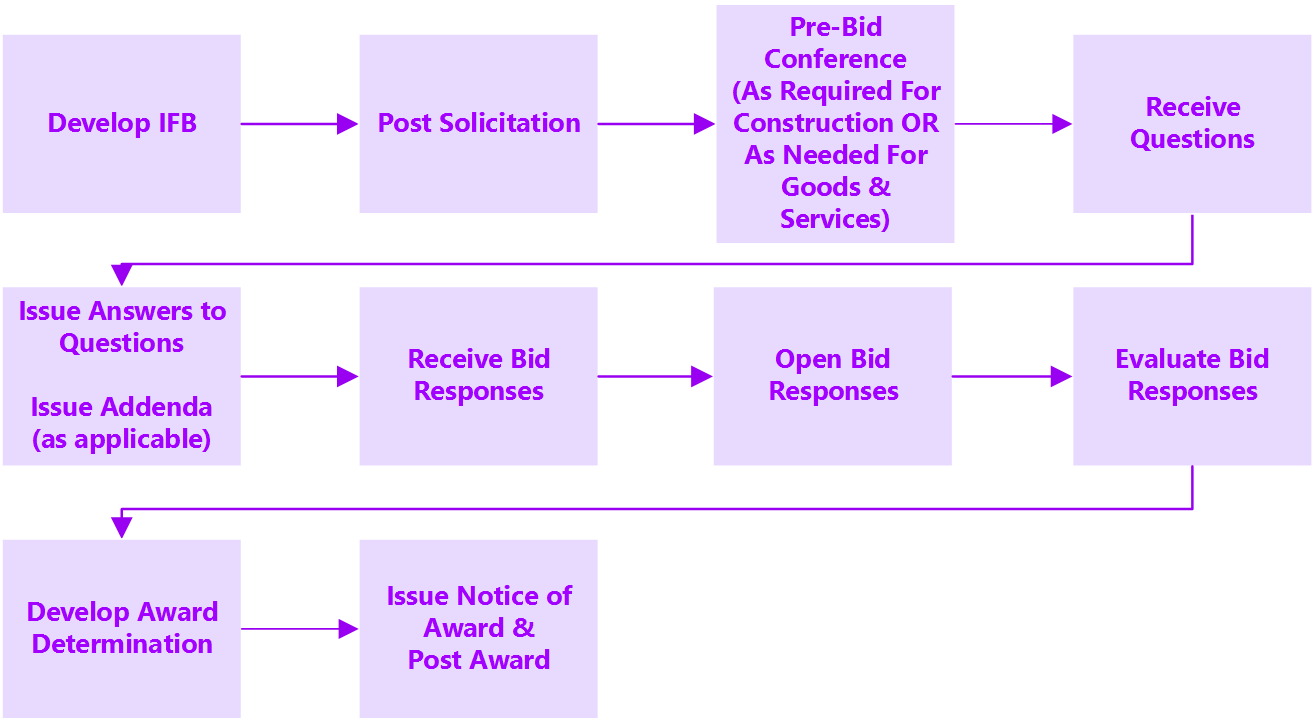
For a detailed description of the processes related to completing the Competitive Sealed Bid method of procurement, refer to Section 4.3.

2.4.3.6 Competitive Sealed Proposals

Competitive Sealed Proposals Basics:

Notice:

Request for Proposals (RFP)

Vendor:

Offeror

Vendor’s Response:

Proposal

Basis of Award:

Responsible offeror whose proposal is most advantageous in accordance with the RFP criteria

Legal Authority:

HRS 103D-303 and HAR 3-122 Subchapter 6

Competitive sealed proposals, or Request for Proposals (RFP), is a formal value-based procurement process, and is most appropriate when:

  • The primary consideration in determining award may not be price;
  • The contract may be other than a fixed-price type;
  • The scope, specifications, and/or delivery requirements for the goods, services, or construction cannot be sufficiently described in the solicitation;
  • Oral or written discussions with offerors may be needed to gain a better understanding of  the technical and price aspects of their proposals;
  • After discussions priority-listed offerors may need the opportunity to revise their proposals, including price; or
  • In order to determine the most advantageous offering to the State, a comparative evaluation wherein the allocation of point values between price, and other non-price factors such as quality, schedule and contractual considerations may be required and set for in the RFP.  

For a detailed description of the processes related to completing the Competitive Sealed Proposal method of procurement, refer to Section 4.4.

2.4.3.7 Professional Services

Professional Services Basics:

Notice:

Request for Qualifications

Contractor:

Offeror

Contractor’s Response:

Statement of Qualifications

Basis of Award:

Most qualified offeror based on evaluation criteria

Legal Authority:

HRS §103D-304 and HAR 3-122 Subchapter 7

The Professional Services procurement method is strictly a qualifications-based method of procurement where price is not considered as part of the evaluation or selection process.  This procurement method requires an agency to perform a multi-phased evaluation and selection process where price will be negotiated only after the most-qualified offeror is selected. Professional Services as defined by HRS Section §103D-104, are those services within the scope of the following professional practices:

  • Architecture
  • Landscape architecture
  • Professional engineering
  • Land surveying
  • Real property appraisal
  • Law
  • Medicine((For executive CPO jurisdiction, health and human services provided to the public as defined in HRS Chapter 103F shall be procured pursuant to HRS 103F, Professional services may not be used.))
  • Accounting
  • Dentistry((For executive CPO jurisdiction, health and human services provided to the public as defined in HRS Chapter 103F shall be procured pursuant to HRS 103F. Professional services may not be used.))
  • Public finance bond underwriting
  • Public finance bond investment banking

Any other practice defined as professional by the laws of this State or the professional and scientific occupation series contained in the United States Office of Personnel Management’s Qualifications Standards Handbook.

Architectural and engineering services furnished by licensees under HRS Chapter 464 shall be procured by this method.((Only if the emergency requirements of HRS §103D-307 are met, professional design services may also be procured utilizing the emergency procurement method.)) Other professional services may be procured in accordance with this process but may also be procured using other available methods of procurement. For a detailed description of the Professional Services procurement method, refer to Section 4.5.

2.4.3.8 Sole Source Procurements

Sole Source Basics:

Notice:

Request for Quote/Proposal

Vendor:

Sole Source

Vendor’s Response:

Quote or Proposal

Basis of Award:        

Responsible source at a fair and reasonable price((In accordance with HRS §103D-312 and HAR §3-122-123 sole source awards over $100,000 require the offeror to submit certified cost and pricing data.))

Legal Authority:

HRS §103D-306 and HAR 3-122 Subchapter 9

For any goods, services or construction not contained on the list of Procurements Approved for Sole Source set forth in HAR 3-122, agencies are required to seek CPO approval by providing justification for the sole source. A Sole Source procurement is a procurement where, based on market research, there is only one (1) supplier of a good, service or construction, brought about by the unique nature of the requirements, supplier, or market conditions. Examples of sole source procurements may include, but are not limited to:

  • Proprietary items;
  • Items with compatibility to existing equipment; or
  • Public utility repair or construction that can only be provided by the utility company.

Examples of procurements that DO NOT meet the justification for a sole source include, but are not limited to:

  • Brand name:  an item is referred to by an exact brand, but there are other brands that qualify as “equals”;
  • Restrictive Specification:  an item that is unique  but available from multiple  suppliers, (subject to CPO approval and bidding);
  • Incumbent/current contractor:  an incumbent contractor/vendor who has been furnishing services to an agency does not, by itself, mean that contractor is the only source for the requirement; or
  • Loss of funding:  a potential loss of funds at the end of a fiscal year.

Procurement Teams should perform extensive market research, as discussed in Section 3, prior to determining to utilize a sole source procurement method.  Sole sources are extremely unusual and are rarely approved by the CPO.  If, after conducting market research, the team determines there is only one source for the goods, services, or construction required, then procedures set forth in Section 4 should be followed.

For The Executive Branch:

For any goods, services or construction not contained on the list of Procurements Approved for Sole Source set forth in HAR 3-122, Executive Branch departments are required to seek CPO approval by completing Form SPO-001, Notice and Request for Sole Source Procurement, providing justification for the sole source. The form must be signed by the HOPA and approved by the CPO prior to issuing a contract, P.O. or pCard payment.

Upon receipt of Form SPO-001, the CPO will post the form to SPO’s notices website for seven (7) days to allow vendors the opportunity to review and submit any inquiries or objections to the Request for Sole Source. If in that time no objections are received, the CPO will review the justification for the Sole Source and, if approved, return it to the agency to execute the contract. If objections are received, the CPO will place the request on hold, review the objection, and provide a written determination to the person submitting the objection and/or the requesting agency.

The CPO makes the final determination regarding the approval or disapproval of a request. If the CPO disapproves a request, the purchasing agency shall use an appropriate method of procurement to obtain the requirement.

Sole source procurements are limited to a maximum performance period of one (1) year. In accordance with HAR §3-122-123, the Procurement Officer agency is required to obtain certified cost or pricing data for sole source procurements exceeding $100,000. Reference Section 3.5 for instructions on requesting and evaluating cost and pricing data.

2.4.3.9 Emergency Procurements

Emergency Purchase Basics:

Notice:

Request for Quote (RFQ)

Vendor:

Bidder

Vendor’s Response:

Quote

Basis of Award:        

As required by the emergency situation

Legal Authority:

HRS §103D-307 and HAR 3-122 Subchapter 10

HRS §103D-307, states that in the case of an emergency, an agency is given latitude to meet the purchasing needs generated by the emergency situation without having to utilize the normal competitive procurement requirements. Although an agency is not required to utilize a competitive procurement method, it is recommended that the agency seek as much competition as possible considering the emergency circumstances.

For an agency’s procurement to meet the definition of an emergency procurement under HRS §103D-307, it must meet ALL of the following three (3) conditions:

  1. A situation of an unusual or compelling urgency creates a threat to life, public health, welfare, or safety by reason of major natural disaster, epidemic, riot, fire, or such other reason as may be determined by the head of that purchasing agency.
  2. The emergency condition generates an immediate and serious need for goods, services, or construction that cannot be met through normal procurement methods and the government would be seriously injured if the purchasing agency is not permitted to employ the means it proposes to use to obtain the goods, services, or construction.
  3. Without the needed good, service, or construction, the continued functioning of government, the preservation or protection of irreplaceable property, or the health and safety of any person will be seriously threatened.

An emergency procurement may only be used to address the immediate needs brought about by the emergency condition, and may not be used for subsequent non-emergency related procurement needs.  Lack of planning or the potential loss of funds at the end of a fiscal year does not constitute an emergency condition.

For the Executive Branch:

Prior to the procurement, or if time does not permit, as soon as practicable thereafter, the HOPA responsible shall complete and submit Form SPO-002, Emergency Procurement, providing justification for the Emergency Procurement and requesting CPO approval.

It is recommended that the affected agency to inform the SPO of the emergency situation as soon as is practicable to ensure the greatest level of coordination and support necessary to address the procurement needs brought about by the emergency condition.

2.4.3.10 Competitive Purchase of Service – Health and Human Services

Competitive Purchase of Service Basics:

Notice:

Request for Proposals (RFP)

Provider:

Applicant

Provider’s Response:

Proposal

Basis of Award:

Most advantageous to the State

Legal Authority:

HRS §103F-402 and HAR 3-143

HRS §103F-402 is specifically used for the purchase of services from health and human services providers. It is a formal, value-based procurement process and is the most frequently used procurement method for purchasing health and human services.

For a detailed description of the processes related to completing the Competitive Purchase of Services method of procurement, refer to Section 4.6.

2.4.3.11 Restrictive Purchase of Service – Health and Human Services

Restrictive Purchase of Service Basics:

Notice:

Request of Restrictive Purchase of Service

Vendor:

Sole Provider

Vendor’s Response:

Quote

Basis of Award:        

HRS 103F-403 and HAR 3-144

HRS 103F-403, Restrictive Purchase of Services is a procurement of health and human services where there is only one (1) provider of the services, brought about by geography, the unique nature of the service need, or funding limitations. Examples of Restrictive Purchase of Services procurements include, but are not limited to:

  • Need for a service in a geographic area available from only one provider;
  • Need for a service with a unique cultural approach designed for a limited target group available from only one provider; or
  • Only one provider satisfies limitations imposed by the funding source.

Examples of procurements that DO NOT meet the justification for Restrictive Purchase of Services include, but are not limited to:

  • Incumbent provider or organization: the incumbent or current provider  that has been furnishing services to an agency does not, by itself, render the provider the only source for the required service;
  • Loss of funding:  the potential loss of funds at the end of a fiscal year; or
  • Failure to plan:  a purchasing agency’s failure to plan ahead sufficiently in order to issue a request for proposals.

For the Executive Branch:

In order to procure using the Restrictive Purchase of Services method, the agency shall complete Form SPOH-500, Notice of and Request for Restrictive Purchase of Service, providing justification for the restrictive purchase. The form must be signed by the HOPA and submitted to the CPO for approval prior to completing the procurement.

Upon receipt of Form SPOH-500, the CPO will post the request to SPO website for a minimum of seven (7) days to allow providers the opportunity to review and submit any inquiries or Notice of Protest. If in that time no protests are received, the CPO will review and take action on the request.  If approved, agencies shall not award a contract until two (2) days after the protest submittal deadline.

If a protest is received, the CPO will place the request on hold, until the protest is settled or resolved.  The protest shall be handled in accordance with processes detailed in HAR 3-148. Protest is also covered in Section 4.8.2.2.  Based on the outcome of the protest, the CPO makes the final determination regarding the approval or disapproval of a request.

If the CPO disapproves a request, the purchasing agency shall choose an appropriate method of procurement.

2.4.3.12 Crisis Procurements – Health and Human Services

Crisis Procurement Basics:

Notice:

Request for Crisis Purchase of Service

Vendor:

Provider

Vendor’s Response:

Quote

Basis of Award:

Meets criteria for Crisis Purchase of Service

Legal Authority:

HRS §103F-406 and HAR 3-147

A crisis is defined as a condition of domestic violence, physical or mental illness or injury, homelessness, lack of food, or such other reason:

  1. that seriously threatens life, the health, or the safety of any person;
  2. where the condition generates an immediate and serious need for health or human services; and
  3. where the need cannot be met through services available from the departments of health or human services, or under other available procurement methods available in HRS 103F.

The crisis method of procurement may only be used to meet current needs generated by the crisis and cannot exceed six months or, with CPO approval, for twelve months.

The HOPA shall submit a written determination to the CPO for approval that a crisis condition exists.  If submission of the determination is not practicable prior to making the purchase, the HOPA may conclude the purchase and submit the request for approval after-the-fact.  The determination shall include:

  1. Nature of the crisis condition
  2. Proposed provider name
  3. Expenditure amount
  4. Service description
  5. Reason for provider selection; and
  6. Other relevant information.

For the Executive Branch:

Prior to the procurement or, if time does not permit, as soon as practicable thereafter, the HOPA responsible shall complete and submit Form SPOH-600, Request for Crisis Purchase of Service, providing justification for the Crisis Purchase and requesting CPO approval.

It is recommended that the affected agency contact SPO to inform them of the crisis situation as soon as is practicable to ensure the greatest level of coordination and support necessary to address the procurement needs brought about by the crisis.

2.4.4 Cooperative Purchasing

Upon request of the CPO, any state or county agency may participate in, sponsor, conduct, or administer a cooperative agreement for goods and services with any other state or county agency in accordance with HRS §103D-801 and HAR 3-128. The purchases shall be made on the same terms and conditions, and under the same rules and regulations as per the agreement entered into between the participants.  At this stage in the procurement process, if there is a multi-agency or state-wide need for this requirement the agency should consider entering into a cooperative purchase agreement to leverage economies of scale and to increase competition and savings.

Procurement by cooperative purchasing agreements shall be conducted in compliance with the requirements of HRS 103D, unless the procurement is initiated by an external to Hawaii procurement entity. If the purchasing agency is going to work with an external purchasing unit, it must comply with public notice requirements for the procurement method, and must ensure that the external public entity does as well, listing the purchasing agency as a participating entity.

Intra-state cooperative purchase agreements must provide that:

  1. A procurement unit shall be designated as lead agency for the procurement;
  2. An order for any good or service shall be placed on an as needed basis by the participating procurement units in accordance with the terms and conditions of the agreement;
  3. Payment for any good or service shall be the exclusive responsibility of the procurement unit which placed the order;
  4. Inspection and acceptance of any good or service shall be the exclusive obligation of the procurement unit which placed the order;
  5. The lead agency for the procurement may terminate the cooperative agreement with a procurement unit for failure of that unit to comply with the terms of the contract;
  6. The exercise of any warranty rights attached to any good or service obtained through a purchase order shall be the exclusive right of the procurement unit which placed the order; and
  7. Failure of a procurement unit that is procuring the good or service from a cooperative agreement contract to secure performance from the contractor pursuant to its terms and conditions, may not necessarily preclude the remaining procurement units from obtaining goods and services from the cooperative agreement contract.

Purchasing entities should note that they are not able to enter into an existing cooperative purchasing agreement, known as piggybacking, including contracts issued by the federal government or other state or local government without prior public notice of an intent to participate.



3.1 Market Research

Section Three: Market Research

3.1 Key Information

3.1.1 Market Research Phase Process Flow

The market research phase of the procurement lifecycle is defined as the process of defining the specific need and determining the most appropriate acquisition method for a procurement.  The market research phase is arguably the most important phase of the procurement lifecycle in that it is where the research is performed, the vast majority of major decisions are made about the procurement, and where the key components necessary to manage the contract after award are incorporated prior to solicitation.

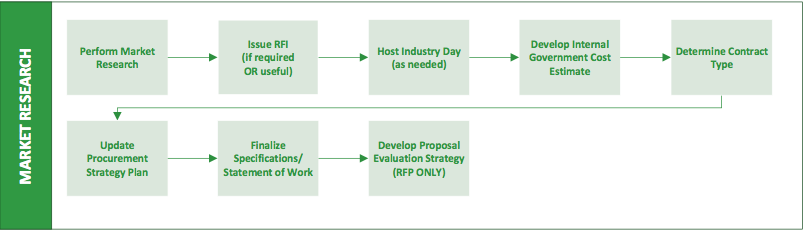
The following are the major steps in the process flow for the market research phase:

MarketResearchPhase

 3.2 Perform Market Research

Once the Procurement Officer has completed the initial Procurement Strategy Plan in collaboration with the Procurement Team, the process of market research should begin. Market research refers to examining available sources of information to find available goods, services, construction and sources of supply, which may meet identified critical business requirements. The level of effort put into market research should be commensurate with the size and complexity of the procurement.

In preparation of a solicitation, the Procurement Team should consider the following factors:

  • Is funding available? What is the project budget?
  • Is the good, service, or construction currently under contract, either at an agency or state level?
  • Who are the major vendors that tend to supply the goods, services, or construction?
  • Is there a meaningful choice of supply in the market?
  • How do local peers contract for the goods, services, or construction?
  • How do other states contract for the goods, services, or construction?
  • What is the estimated cost/price other agencies/States have paid for goods, services and construction similar in scope and magnitude to your procurement?

While an exhaustive review of sources of supply may not be feasible or practical, the goal of market research is to identify a variety of potential sources of supply. By identifying the potential sources of supply, the Procurement Officer and Procurement Team are able to analyze various goods, services, and construction offerings. Studying various offerings is essential to developing a solicitation that is not biased in favor of a single source of supply or otherwise reducing the pool of suppliers capable of meeting the state’s critical business requirements.

Although the Procurement Team may have knowledge of certain specific goods, services, or suppliers, the Procurement Officer should not rely exclusively on stakeholders’ knowledge. Instead, the Procurement Officer must actively engage in market research by accessing informational resources such as the Internet, industry organizations, consultant reviews, advertisements, cooperative procurement entities, or industrial publications. The Procurement Officer should also consult with other public entity Procurement Officers with similar purchasing needs, both within and outside of Hawaii.

As potential sources of supply are identified, the Procurement Officer may contact potential suppliers directly to request information. The Procurement Officer’s contact with potential suppliers may occur informally, such as by telephone or email. The Procurement Officer may determine a more formal method of gathering information from suppliers, such as the Request for Information discussed below.

3.3 Request For Information (RFI)

A Request for Information (RFI) is a method for requesting information from suppliers who have knowledge or information about an industry, goods, services, or construction. The Procurement Officer should use the RFI method when it is considered impractical to initially prepare a definitive purchase description,  when informal discussions with vendors are not productive, or it is required by statute, HRS 103F.((The Request for Information discussed in this section should not be confused with the mandatory Request for Information required in purchases of Health and Human Services under HRS 103F and HAR 3-142.))  The RFI process for HRS 103F procurements is discussed in Section 4.6.

The RFI method is not a competitive solicitation method and, as a result, does not satisfy the requirement for competitive bidding. The RFI method is no more than an information gathering tool, and such information gathered may or may not be used by the state agency to develop a competitive solicitation.

The RFI should detail the objective of the procurement and include, but not be limited to:

  • A description of the information requested of vendors;
  • A method for receiving the requested information;
  • A statement that the response is to provide the purchasing agency with recommendations that will serve to accomplish the work required by the procurement;
  • A statement that the purchasing agency reserves the right to incorporate in a solicitation, if issued, any recommendations presented in the response to the request for information; and
  • A statement that neither the purchasing agency nor the supplier responding has any obligation under the request for information.

If the Procurement Team has developed an initial specification or statement of work, it can provide this in the RFI and ask that vendors validate the requirements and provide feedback and comments that will help the State reach its procurement objectives.

While an RFI can be useful, it should only be used when truly seeking input from the vendor community for the solicitation. If the Procurement Team does not intend to incorporate the information and/or feedback it receives then it should not utilize the RFI method. Also Procurement Teams are strongly cautioned against using an RFI as a method to restrict future competition on the resulting solicitation.  This can occur when in the team incorporates only the proposed delivery model or other unique features of a single bidder in the final scope or specifications.  Vendors are not required to respond to an RFI and a vendor’s failure to respond to an RFI will not prohibit the vendor from responding to any competitive solicitation that may result from the RFI.

3.4 Industry Day

An agency may consider holding an industry day event in order to present its plans for a current or future procurements and seek input concerning current industry practices related to the requirement from members of the vendor or contractor community. An industry day is usually held prior to the release of an RFP. It is an opportunity for the agency to provide the vendor community with a detailed overview of its procurement requirements and solicit feedback about the procurement. Various methods for hosting these meetings may be offered, such as webinars, video conferences, telephone conferences, or other methods.

Industry days are particularly useful when an agency has a complex program or project where multiple contracts of varying scope and magnitude will be required to complete the project.  Industry day goals include:

  • Ensuring collaboration between the agency program office and vendors
  • Incorporating vendor comments into the RFP development process
  • Communicating program requirements and schedule
  • Gaining a better understanding of recent industry or market developments
  • Providing updates to vendors on future program developments and procurements
  • Providing a forum for contractors to network with potential subcontractors, subconsultants, and/or the small business community for upcoming procurements.

3.5 Internal Government Estimate

In the market research phase the Contract Administrator, working with the Procurement Team, should take the time to develop an internal government estimate for the anticipated cost of the requirement. The internal estimate must be independent from the offeror’s proposal, which is why this estimate is often called an Independent Government Estimate. Independent development is vital because this estimate normally provides your first indication of a reasonable contract price and it is also one of the bases that you should consider in contract price analysis. The estimate development process may be automated or manual, but the best estimates reflect the findings from the market research. Section 4.7.2 covers elements of cost or price analysis to establish the estimated cost of the requirement. For in-depth guidance on developing your internal estimate, refer to our Basic Pricing Guide, Chapters 2 and 3 on Independent Government Estimates.


3.6 Determine Contract Type

3.6 DETERMINE THE CONTRACT TYPE

Another key decision that must be made during the planning phase is what contract type to utilize.  Unlike the method of procurement, that determines how you are going to solicit bids for the project, the contract type will determine how the bidders will price the goods, services or construction and the contracting environment that will govern the contractual relationship between the State and the Contractor post contract award.  Based on market research the Procurement Team should have a good idea how the contractor industry prices work similar to your requirement. This market research will be critical in helping you determine the contract type to solicit.

The Hawaii procurement code allows for a number of contract types including everything from a firm-fixed price or lump sum contract to a time and materials contract.  See HAR 3-122 Subchapter 16 for a list of contract types.

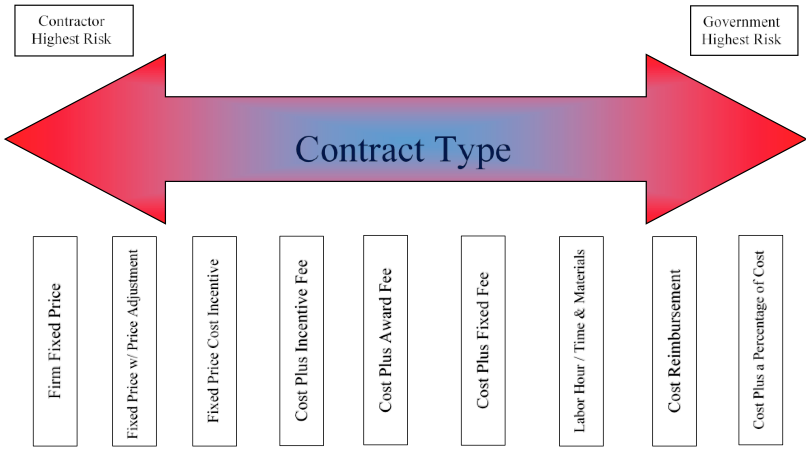
The key factor that drives what contract type should be used on any given project is the level of project risk and how to fairly allocate that risk between the State and the Contractor.  The chart below shows a continuum of contract types and the associated risk level to either the State or the Contractor.

The following sections provide an overview of the types of contracts available for use in the State of Hawaii

ContractTypes

3.6.1 Fixed Price Contracts

The fixed price contract is the only type of contract that can be used in competitive sealed bidding. It places responsibility on the contractor for the delivery of the goods or the complete performance of the services or construction in accordance with the contract terms at a price that may be firm or may be subject to contractually specified adjustments. It is appropriate for use when the extent and type of work necessary to meet the purchasing agency’s requirements can be reasonably specified and the cost can be reasonably estimated, as is generally the case of construction or standard commercial products or some services.

There are two types of fixed price contracts. The firm fixed-price provides a price that is not subject to adjustment due to variations in the contractor’s cost of performing the work specified in the contract. It should be used whenever prices which are fair and reasonable to the purchasing agency can be established at the outset.

The fixed-price contract with price adjustment provides for variation in the contract price under special conditions defined in the contract, other than customary provisions authorizing price adjustments due to modifications to the work. The formula, pricing index or other basis by which the adjustment in contract price can be made must be specified in the solicitation and the resulting contract. Adjustment allowed may be upward or downward only or both depending on the requirement.

An indefinite quantity contract, where the unit price is set but the total number of units may not be set, is a type of fixed price contract.

3.6.2 Cost Contracts

The cost-reimbursement contract, provides for payment to the contractor of allowable costs incurred in the performance of the contract and as provided in the contract. It establishes at the outset an estimated cost for the performance of the contract and a dollar ceiling which the contractor may not exceed, except at its own expense, without prior approval or subsequent approval by the Procurement Officer. It has a provision whereby the contractor agrees to perform as specified in the contract until the contract is completed or until the costs reach the specified ceiling, whichever occurs first.

It is appropriate when the uncertainties involved in contract performance are of the magnitude that the cost of contract performance cannot be estimated with sufficient certainty to realize economy by use of any type of fixed-price contract. It is particularly suitable for research, development, and study type contracts. This contract type necessitates appropriate monitoring by agency personnel during performance to provide reasonable assurance that the objectives of the contract are being met.

It may be used only when it is determined that:

  • A contract is likely to be less costly to the purchasing agency than any other type or that it is impracticable to obtain otherwise the goods, services, or construction;
  • The proposed contractor’s accounting system will permit timely development of all necessary cost data in the form required by the specified contract type contemplated; and
  • The proposed contractor’s accounting system is adequate to allocate costs in accordance with generally accepted accounting principles.

The cost-plus-fixed fee contract is another type of cost-reimbursement contract. It provides for payment to the contractor of an agreed fixed fee in addition to reimbursement of allowable incurred costs. The fee is established at the time of contract award and does not vary whether or not the actual cost of contract performance is greater or less than the initial estimated cost established for the work. Thus, the fee is fixed but not the contract amount because the final contract amount will depend on the allowable costs reimbursed. The fee is subject to adjustment only if the contract is modified to provide for an increase or decrease in the scope of work specified in the contract.

The cost-plus-fixed fee contract can be either a completion form or term form. The completion form is one that describes the scope of work to be performed as a clearly defined task or job with a definite goal or target expressed and with a specified end-product required. This form of cost-plus-fixed fee contract normally requires the contractor to complete and deliver the specified end-product as a condition for payment of the entire fixed-fee established for the work and within the estimated cost if possible. However, in the event the work cannot be completed within the estimated cost, the agency can elect to require more work and effort from the contractor without increase in fee provided it increases the estimated cost. The term form is one that describes the scope of work to be performed in general terms and that obligates the contractor to devote a specified level of effort for a stated period of time. The fixed fee is payable at the termination of the agreed period of time. Payment is contingent upon certification that the contractor has exerted the level of effort specified in the contract in performing the work called for and that the performance is considered satisfactory by the purchasing agency.

The completion form of the cost-plus-fixed fee contract is preferred over the term form whenever the following can be defined with sufficient precision to permit the development of estimates within which prospective contractors can reasonably be expected to complete the work:

  • The work itself; or
  • Specific milestones which are definable points in a program when certain objectives can be said to have been accomplished.

In no event should the term form of the cost-plus-fixed fee contract be used unless the contractor is obligated by the contract to provide a specific level-of-effort within a definite period of time.

The cost-plus-a-percentage-of-cost contract is another type of cost-reimbursement contract. Prior to completion of the work, the parties agree that the fee will be a predetermined percentage of the total cost of the work. The contract provides incentive for the contractor to incur cost at the expense of the State since the more the contractor spends, the greater its fee.

Cost-reimbursement and cost-plus-a-percentage-of-cost contracts may only be utilized when the Procurement Officer determines in writing that the contracts are likely to be less costly than any other type of contract or that it is impracticable to obtain the goods, services, or construction required except by means of the contracts.

They are prohibited if their use would jeopardize the receipt of federal assistance funds or reduce the amount of the assistance under any applicable federal statute or regulation.

In addition, award of a cost-plus-a-percentage-of-cost contract may not be made unless:

  • Notice is given to the head of the compliance audit unit, president of the senate, speaker of the house of representatives, and the chairpersons of the senate ways and means and house finance committees; and
  • Notice is conspicuously posted in an area accessible to the public in the office of the Procurement Officer and available for public inspection during normal business hours.

For HRS 103F the SPO has established cost principles for purchases of Health and Human Services.

3.6.3 Cost Incentive Contracts

The cost-incentive contract that provides for the reimbursement to the contractor of allowable costs incurred up to the ceiling amount and establishes a formula whereby the contractor is rewarded for performing at less than target costs or is penalized if it exceeds target cost. The profit or fee under the contract will vary inversely with the actual, allowable costs of performance and consequently is dependent on how effectively the contractor controls cost in the performance of the contract.

The fixed-price cost incentive contract is one type of cost incentive contract. The parties establish at the outset a target cost, a target profit, a formula that provides a percentage increase or decrease of the target profit depending on whether the actual cost of performance is less than or exceeds the target cost, and a ceiling price. After performance of the contract, the actual cost of performance is arrived at based on the total incurred allowable costs as provided in the contract. The final contract price is then established in accordance with the formula using the actual cost of performance. The final contract price may not exceed the ceiling price. The contractor is obligated to complete performance of the contract, and, if actual costs exceed the ceiling price, the contractor suffers a loss.

The fixed-price cost incentive contract serves three objectives:

  1. It permits the establishment of a firm ceiling price for performance of the contract that takes into account uncertainties and contingencies in the cost of performance.
  2. It motivates the contractor economically since cost is in inverse relation to profit– the lower the cost, the higher the profit.
  3. It provides a flexible pricing mechanism for establishing a cost sharing responsibility between the State and contractor depending on the nature of the goods, services, or construction being procured, the length of the contract performance, and the performance risks involved.

The cost-reimbursement contract with cost incentive fee is another type of cost-incentive contract. The parties establish at the outset a target cost, a target fee, a formula for increase or decrease of fee depending on whether actual cost of performance is less than or exceeds the target cost, with maximum and minimum fee limitations, and a cost ceiling which represents the maximum amount which the agency is obligated to reimburse the contractor. The contractor continues performance until the work is complete or costs reach the ceiling specified in the contract. After performance is complete or costs reach the ceiling, the total incurred, allowable costs reimbursed in accordance with subchapter 15 and as provided in the contract are applied to the formula to establish the incentive fee payable to the contractor. This type of contract gives the contractor a stronger incentive to efficiently manage the contract than a cost-plus-fixed fee contract provides.

Prior to entering into any cost incentive contract, or any cost-reimbursed contract with cost incentive fee, the Procurement Officer shall make the written determination.

3.6.4 Performance Incentive Contracts

In a performance incentive contract, the parties establish at the outset a pricing basis for the contract, performance goals, and a formula that varies the profit or the fee if the specified performance goals are exceeded or not met. For example, early completion may entitle the contractor to a bonus while later completion may entitle the State to a price decrease.

3.6.5 Time and Materials Contracts

A time and materials contract provides an agreed basis for payment for materials supplied and labor performed. A time and materials contract shall, to the extent possible, contain a stated ceiling or an estimate that shall not be exceeded without prior agency approval. A time and materials contract shall be entered into only after the Procurement Officer determines in writing that:

  • Contractor has an adequate accounting system that accumulates and segregates costs in a manner that is traceable to the project level;
  • Agency personnel have been assigned to closely monitor the performance of the work; and
  • In the circumstances, it would not be practicable to use any other type of contract to obtain needed goods, services, or construction, in the time required, and at the lowest cost or price to the purchasing agency.

3.6.6 Labor Hour Contracts

A labor hour contract provides only for the payment of labor performed. A labor hour contract shall contain the same not to exceed pricing ceiling as the time and materials contract. A labor hour contract also requires the same determination as required for a time and materials contract.

3.7 Update Procurement Strategy Plan

After completing the necessary market research, the Procurement Team should update the original Procurement Strategy Plan based on the market research data. This can be done by updating existing components of the Procurement Strategy Plan or by adding additional information or sections to the original Plan. The goal is to document in a single place the information garnered during the market research phase as it impacts the procurement strategy (i.e., scope, schedule, budget, method of procurement, requirements, etc.).  Remember your Procurement Strategy Plan is a dynamic document that should be updated as new information is received.


3.8 Finalize Specs/Scope

3.8 Finalize Specifications/Statement of Work

3.8.1 Gathering Requirements

The Procurement Officer must facilitate open dialogue with the identified stakeholders to gather requirements for the procurement. Requirements are the essential features and functions that must be met by the provided good or service. The Procurement Officer should encourage discussion and ask sufficient and pertinent questions to ensure the stakeholders fully understand the requirements. Some examples of questions to consider when collecting requirements are:

  • Who/what area is impacted by this procurement?
  • What are the key functions the needed goods/services must meet?
  • What factors will impact this purchase?
  • When are the goods/services needed?
  • Where will goods be delivered and/or services performed?
  • Why are the goods/services needed?
  • How must goods/services be provided or delivered?
  • What key approvals are necessary and who must provide these approvals?
  • What specific quality or quantity needs must be considered?

If the requirements are incorrectly, inaccurately, or incompletely specified there is little chance the proposed solution will meet agency expectations. Taking the time to ask these questions and elicit input from the Procurement Team will improve the procurement outcomes.

3.8.2 Develop Detailed Specifications/Scope of Work

A specification is any description of the physical or functional characteristics, or of the nature of a good, service, or construction item.  The term includes descriptions of any requirement for inspecting, testing, or preparing a good, service, or construction item for delivery. A specification should describe the features and functions of a product or service an agency seeks to procure along with a description of what a vendor must offer to be considered for an award. Specifications are the primary means of communicating agency requirements to the vendor community.

Specifications determine and control the:

  • Minimum quality level of the product or service;
  • Suitability of the product or service for the job to be done; and
  • Method of evaluation used in making an award and determining the best value proposal for the purchase.

The Procurement Officer should develop specifications that meet the following characteristics:

  1. SIMPLE: Avoid unnecessary detail, but provide sufficient information to ensure that requirements will satisfy their intended purpose.
  2. CLEAR: Use terminology that is understandable to the agency and proposers. Use correct spelling and appropriate sentence structure to eliminate confusion. Avoid legalese, specialized language and jargon whenever possible.
  3. ACCURATE: Use units of measure compatible with industry standards. All quantities and packing requirements should be clearly identified.
  4. COMPETITIVE: Identify at least two commercially available brands, makes, or models (whenever possible) that will satisfy the intended purpose. Avoid unneeded “extras” that could reduce or eliminate competition and increase costs.
  5. FLEXIBLE: Avoid inflexible specifications that prevent the consideration or acceptance of a proposal, which could offer greater performance for fewer dollars. Use approximate values such as dimensions, weight, speed, etc. (whenever possible) if they will satisfy the intended purpose. If approximate dimensions are used, they should be within 10% unless otherwise stated in the solicitation document.

The end product of a well-written specification should be expressed as SMART:

  • Specific – clearly states what is required
  • Measurable – to confirm when it has been met
  • Achievable – can be done, is technically possible
  • Realistic – is reasonable, is not cost prohibitive
  • Timely – achievable within an acceptable timeframe

A scope of work, sometimes called a statement of work, or scope of services, is a description of the requirements of services to be performed. The scope of work may include material requirements to perform the needed services.  A scope of work should contain the following information:

  • Background of the procurement
  • Objectives to be achieved
  • Contractor’s tasks
  • Deliverables
  • Schedule (performance, deliverables and payment)
  • Department responsibilities

3.8.2.1 Mandatory Specifications

As the Procurement Team works to develop the specifications it should be aware of statutorily mandated specifications as detailed in Part IV of HRS-103D. In accordance with HRS §103D-405, specifications shall seek to promote overall economy and encourage competition, and shall not be unduly restrictive.

Examples of statutory specifications set forth in the procurement code include, but are not limited to:

  • Roadway construction materials
  • Construction materials
  • Hawaiian plants in public landscaping
  • Light duty vehicles
  • Recycled products

Outside contractors may be utilized to prepare specifications and work statements in the development of a solicitation.  Contractors paid for those services are not allowed to bid on or receive a contract when they participated in any way in the development of the solicitation package or any resulting contract.  In all cases, the Procurement Officer and Team should review these statutory requirements to ensure they are properly incorporated into their specifications, as appropriate.

3.8.2.2 Mandatory Specifications for Competitive Purchase of Services – Health and Human Services

HRS §103F-402, Competitive purchase of services, was established to promote uniformity in health and human service procurement. Service specifications shall address in detail each of the following items and if an item is not applicable to the request for proposals, the specification must state that it is not applicable:

  1. Minimum or mandatory activities
  2. Probable funding amounts, source, and period of availability
  3. The need or problem the service addresses
  4. Goals of the service
  5. Target population to be served
  6. Geographical coverage of service
  7. Expected outcome measurements
  8. Units of service and unit rate, as applicable
  9. Quality assurance and evaluation specifications, as applicable
  10. Whether single or multiple contracts are to be awarded and define the criteria for the multiple award, if applicable
  11. Whether single- or multi-term contracts are to be awarded and define the terms, including but not limited to initial contract term and conditions for extension
  12. Reporting requirements for program and fiscal data, and provide sample forms and instructions, as available or appropriate
  13. Minimum or mandatory administrative requirements
  14. Minimum or mandatory personnel requirements
  15. Pricing or pricing methodology to be used, as applicable
  16. The method or procedure for compensation or payment


3.9 Develop Proposal Evaluation Strategy

3.9 Develop Proposal Evaluation Strategy

Proposal evaluation, particularly in a RFP, usually consists of an evaluation of mandatory requirements, evaluation criteria and cost/price.  The evaluation criteria used to assess proposals consist of the factors and sub-factors that reflect the areas of importance to an agency in its selection decision. Through the evaluation factors, the agency is able to assess the similarities and differences and strengths and weaknesses of competing proposals and, ultimately, use that assessment in making a sound selection decision. In accordance with HRS §103D-303 for goods, services and construction and HAR §3-143-205(d), for health and human services, the evaluation criteria and their relative point value shall be expressed in the RFP and proposals shall be evaluated only on the basis of those criteria. In addition, the RFP must state the relative point value of price to all of the other evaluation criteria. In doing so, offerors are informed of the factors that the agency will consider in determining which proposal best meets its needs, and offerors may use this information to determine how to best prepare their proposals.

In general, evaluation criteria should be tailored to each procurement and include only those factors which will have an impact on contractor selection. The nature and types of evaluation criteria to be used for an acquisition are within the broad discretion of the agency. In order to determine the point allocation for the price /cost factor please refer to the formula discussed below.

Non-cost factors address the evaluation areas associated with technical and business management aspects of the proposal. Examples of non-cost factors include technical and business management concerns such as technical approach and understanding, capabilities and key personnel, transition plans, management plan, management risk, past performance, and corporate resources. The level of quality needed by the agency in performance of the contract is an important consideration in structuring non-cost factors.

Mandatory requirements are requirements an offeror must meet to demonstrate they are legally or otherwise authorized to perform the work described in the RFP. This may include such things as business and/or contractor licensing or board certifications, proof of insurance, bonding requirements, etc. Mandatory requirements are evaluated on a pass-fail basis.

3.9.1 Evaluation Process

The evaluation process is typically divided into four (4) main phases and one (1) optional one. The evaluation phases are:

  1. Evaluation of Mandatory Requirements
  2. Evaluation of Technical Proposals
  3. Evaluation of Cost Proposals
  4. Ranking and Selection
  5. Optional Discussions and Best and Final Offers  (Final Revised Proposals HRS 103F)

The specific steps and processes the Procurement Team will utilize in each step in the evaluation process should be documented in an evaluation plan. This ensures that at the time of evaluation there is a clear and documented process for how the solicitation responses will be evaluated.

3.9.2 Evaluation Factors

It is important to identify all evaluation factors and their relative importance, including price, prior to RFP development. Factors not specified in the RFP shall not be used for evaluating the proposals.

Next, the Procurement Team should begin making a detailed list of the most important aspects of the goods, services or construction required, including cost. Each item on the list is a potential evaluation criterion. From this list, the Procurement Team should group the criteria into categories, referred to as evaluation factors, and arrange the list in sequence of most important. This process will help to determine the most appropriate weighting (see below) and aid in assigning a point value to each factor based on its relative importance. The most important items will naturally be evaluated heavier and have more points available.

Evaluation factors should be individually tailored to each RFP. For criteria to be effective, they should have the following characteristics:

  • Clear: not subject to multiple interpretations, not ambiguous
  • Relative: all key elements of the project requirements must relate to the requirement definition and be covered by evaluation criteria
  • Discriminating: separate best, average and weaker proposals
  • Non-discriminatory: fair and reasonable
  • Realistic: given the nature or value of the contract
  • Measurable:  must have distinguishing importance
  • Economical: use of the criteria should not consume an unreasonable amount of time or resources
  • Justifiable: make sense and can be justified on common sense, technical and legal basis; mandatory and heavily weighted criteria must be justified

3.9.3 Weighting Factors

Weights reflect the relative importance of each of the evaluation criteria to the agency.  A statement in the RFP of the specific weighting to be used for each factor and subfactor, while not required, is recommended so that all offerors’ will have sufficient guidance to prepare their proposals.

Typically, factors are divided in four (4) major categories for evaluation purposes:

  1. Technical approach
  2. Managerial approach
  3. Qualifications, prior experience (past performance) and references
  4. Cost

In accordance with HAR §3-122-52(b), points assigned to each factor must be presented in the RFP using a numerical rating system, that details the relative priority of each evaluation factor. The following is an example of evaluation factors used in an RFP with a weighted 60/40 split between cost and technical/managerial merit.

Sample Evaluation Factor

Points

Technical Approach

400

Managerial Approach

50

Qualifications, prior experience and references

150

Cost

400

Total Points

1000

In accordance with HAR §3-122-52(d), cost is identified as a percentage of the total available points and cost proposals from all offerors are “normalized” meaning that the lowest cost offeror receives 100% of the points available and the other higher cost proposals receive a percentage of the available points based on their submitted cost.

The following is an example of a cost evaluation using the formula mandated in HAR §3-122-52.((This formula described in this section does not apply to procurements under HRS 103F.))

Sample Cost Normalization

Points

((Low Bid / Offeror Bid) x Total Points)

Offeror 1 – Low Bidder at $26,000 gets maximum points

400 = (($26,000 / $26,000) x 400)

Offeror 2 – Next Low Bidder at $28,400 gets 91.5% of points

366 = (($26,000 / $28,400) x 400)

Offeror 3 – Highest Bidder at $40,000 gets 65% of points

260 = (($26,000 / $40,000) x 400)

3.9.4 Evaluation Committee

Prior to writing an RFP or Competitive Procurement of Services, the purchasing agency must determine whether the solicitation responses will be evaluated by the Procurement Officer exclusively, or by an evaluation committee of named participants.  The following details the requirements for evaluation committees for each of these methods of procurement.

3.9.4.1 RFP Evaluation Committee

Although responses to an RFP may be evaluated by the Procurement Officer, it is generally considered best practice to establish a committee to evaluate proposals for an RFP.

In accordance with HAR §3-122-45.01, if an evaluation committee is used it must be composed of a minimum of three (3) governmental employees with sufficient qualifications in the area of the goods, services, or construction to be procured, one of which must be the contract administrator. The contract administrator or a designee shall serve as chairperson, and the Procurement Officer or a designee shall serve as advisor.

Private consultants may also serve (without compensation) on the committee provided that they have the relevant knowledge, do not have a conflict of interest, agree to keep the evaluation and all information they view confidential, and agree to their name being made public upon the award of the contract.  See Section 4.4.4 for guidance on how to evaluate proposals.

For the Executive Branch:

Individuals serving on the Evaluation Committee should be documented on form SPO-044, and each member must complete form SPO-024, Attestation Serving on an Evaluation, Review or Selection Committee to ensure that there are no potential conflicts.

3.9.4.2 Competitive Purchase of Services Evaluation Committee

For HRS 103F, The Procurement Officer or an evaluation committee selected by the Head of the Purchasing Agency or the Procurement Officer shall review and evaluate the proposals.  The approved list of evaluators shall be placed in the procurement file.

Evaluators:

  1. The Procurement Officer; or
  2. A Committee of a minimum of two state employees with the education and training to evaluate the proposals

Non-state employees may serve as advisors only if there is no conflict of interest and shall not represent or act in the selection or award process.

A copy of the document identifying the evaluation committee members and any subsequent changes thereto shall be kept in the procurement file. See Section 4.6.7 for guidance on how to evaluate proposals.


4.1 Solicitation & Award

SECTION FOUR: SOLICITATION AND AWARD

4.1 KEY INFORMATION

4.1.1 SOLICITATION AND AWARD PHASE PROCESS FLOW

The Solicitation and Award phase of the procurement lifecycle is defined as the process of acquiring goods, services, or construction through an open, competitive solicitation process and includes the following steps: solicitation development; solicitation issuance; proposal receipt; evaluation; discussions (if applicable); and contract award.

SolicitationAwardPhase


4.2 Small Purchases

4.2 Small Purchases Process

If a requirements falls under the dollar thresholds discussed below, the Agency should purchase the goods, services or construction using the streamlined processes for the small purchase method of procurement.

The following table outlines the small purchase thresholds and the associated types of small purchase procedures state agencies are required to use for each. Agencies may establish stricter internal policies and processes related to small purchases, however they must meet the following requirements at a minimum.

Amount of Purchase

Type of Procurement

Minimum Number of Quotes

Affected Agencies

$0.01 – $4,999

All (HRS 103D and 103F)

Adequate, reasonable competition

All State Agencies

$5,000 – $14,999

All (HRS 103D and 103F)

Minimum Three Quotes (phone, fax, email)

All State Agencies

$15,000 – $24,999

All (HRS 103D and 103F)

Minimum Three Written Quotes

Other CPO Jurisdictions Only, and HRS 103F procurements

$15,000 – $99,999

$15,000 – $249,999

Good/Services

Construction((Performance and Payment Bonds are required for all small purchase construction procurements $50,000 or greater.)) (HRS 103D)

Minimum Three Quotes via eProcurement system

Executive Branch Agencies Only

$25,000 – $99,999

$25,000 – $249,999

Good/Services

Construction((Performance and Payment Bonds are required for all small purchase construction procurements $50,000 or greater.))(HRS 103D)

Minimum Three Quotes via eProcurement system

Other CPO Jurisdictions Only

Note: Professional service procurements for professions under HRS 464 shall use the process set forth in HRS §§103D-304 or 103D-307, if applicable.

The small purchase process may be used for purchases within the small purchase thresholds outline above, and where award is based on the lowest responsive, responsible quote. Small purchases are generally simple to procure and administer while providing for as much competition as is practicable. Public notice and public bid opening are not required.  The small purchase method of procurement may not be used when the solicitation requires a vendor to propose something other than price OR where award must be based on criteria other than lowest price. ((This section does not apply to small purchases under HRS 103F.))

Additionally, agencies shall not parcel or artificially or intentionally divide a purchase for the same, like, or related items of goods, services, or construction into several purchases or smaller quantities, in order to utilize the small purchase process and avoid statutory competitive requirements.

If an Executive Branch agency utilizes the small purchase method, then upon finalization of the specifications, the agency should execute the procurement in accordance with the process outlined below.

For purchases of $5,000 but less than $15,000 ($25,000 for HRS 103F), the agency must obtain a minimum of three (3) quotations. Quotes may be obtained by telephone, email, fax, or by posting a solicitation to the respective eProcurement system. All quotes must be documented in the contract file.  Although an agency is only required to seek three (3) quotations, it should seek to acquire quotations from as many viable sources as possible to ensure the best price is obtained and maximum competition is generated.

Agencies obtaining quotes outside of an eProcurement system must maintain a small purchase procurement/contract file containing the price quotations requested, quotations received, and a tabulation of prices offered documented on Form SPO-010. Once the quotes have been evaluated, the purchasing officer must document the determination of award on Form SPO-010, and file it with the procurement/contract file, documenting the basis for placing the order with the chosen vendor. The agency must retain these records for audit and review purposes. With the use of an eProcurement system, an agency is NOT required to utilize Form SPO-010 to document. Instead, it can print the award summary report on eProcurement for its small purchase order file.

For the Executive Branch 

HRS 103D small purchases of $15,000 to less than $100K goods and services or less than $250K for construction, the agency must procure the requirement by utilizing the State eProcurement system.

After the executive agency has selected a vendor, documented its determination, and verified vendor compliance utilizing Hawaii Compliance Express (HCE) or receipt of equivalent hard copies, it should consider whether the vendor will accept and can be paid in accordance with guidelines for the State purchasing card (p-Card). If so, the agency should provide the P-Card information to the vendor as payment for the small purchase. If not, the purchasing officer will need to forward an approved Purchase Order to the vendor for processing.

 Small Purchases awards for goods, services and construction $2,500 and above must be posted to the SPO website. All small purchase awards for health and human services shall be posted to the SPO Health and Human Services contract awards website.


4.3 Competitive Sealed Bidding

4.3 Competitive Sealed Bidding Process

Once it has been decided in the planning process that competitive sealed bidding is the appropriate method, the process below shall be followed. The Competitive Sealed Bidding process is outlined in the graphic below, and detailed in the following sections.

IFB-Process_r1_p40

4.3.1 Develop the IFB

In accordance with HAR §3-122-21, the following are the minimum required components of any IFB:

  1. Instructions and information to bidders concerning the bid submission requirements, including:
    1. The time and date set for receipt of bids;
    2. The address of the office to which bids are to be delivered or if bid submittal is required through an electronic procurement system;
    3. The maximum time for bid acceptance by the Procurement Officer issuing the bid; and
    4. Any other special information, such as any requirement of intention to bid, if required, or the time, date, and location of the pre-bid conference.
  2. Specifications and/or Scope of Work, minimum/mandatory requirements, delivery or performance schedule, and inspection and acceptance requirements
  3. Contract terms and conditions
  4. Bid form including price
  5. Documents incorporated into the IFB by reference, provided that the IFB specifies where the documents can be obtained
  6. A statement that bidders shall designate those portions of their bid that contain trade secrets or other proprietary data that are to remain confidential
  7. A statement that the bidder must sign the bid form in ink and submit the bid form with the original signature included in the offer, unless the bid offer is being submitted through an eProcurement system
  8. For construction projects, instructions to the bidder that the bidder shall include in its offer information on joint contractor and/or subcontractor

Agencies are encouraged to incorporate these elements and any other agency-specific requirements into a checklist to ensure compliance with all requirements prior to releasing the IFB.

The IFB document may require internal agency reviews and approvals prior to posting the Public Notice or releasing the IFB on an eProcurement system.

4.3.2 Public Notice

Once approved, the purchasing agency must advertise the bid opportunity to potential bidders through a public notice.((Solicitations posted on an eProcurement system satisfy this public notice requirement. Advertisement through a public notice is intended to maximize competition.))

For the Executive Branch

At a minimum, public notices shall be posted on the SPO notices site and may also be publicized by other means including but not limited to:

  1. Statewide newspapers
  2. Mainland newspapers
  3. County-wide publications
  4. Industry-specific publications/journals
  5. Mail
  6. Fax
  7. Email

A public notice must include the following information:

  1. A brief description of the goods, services, or construction  required,
  2. Where and when the solicitation will be available and a phone number or e-mail address where interested parties may request or obtain a copy,
  3. The deadline for the responses to the solicitation, and
  4. Other appropriate information (e.g., the time, date, and location of the pre-bid conference).

All bid opportunities are required to be published for a minimum of ten (10) calendar days between the first posting date and the date set for receipt and opening of bids. During the advertisement period, prospective bidders may only contact the purchasing agency for inquiries and clarifications in accordance with the solicitation requirements. Inquiries and responses shall be made uniformly available to all potential bidders and, if required, the procurement officer shall issue an addendum to the IFB that details any changes to the IFB.

Addenda are typically used to communicate material changes to the IFB, correct minor defects, and provide information or clarification to potential bidders. If the purchasing agency must amend the IFB, it may need to consider the impact to the potential bidder and determine if additional time should be given for submission of bids.

4.3.2.1 Pre-Bid Conference

A pre-bid conference is conducted to explain the procurement requirements to a potential bidder and allow a potential bidder to ask questions.

In accordance with HRS 103D-303.5, a pre-bid conference is required for all construction projects with a total estimated contract value of $500,000 or more and design-build projects with an estimated value of $100,000 or greater. IFBs for goods and services and construction below the dollar thresholds, may include a pre-bid conference.  Such events shall be specified in the IFB, including date, time and location of the event.

Construction projects and design-build project within the dollar thresholds, shall allow for a minimum of fifteen (15) calendar days between the date of the pre-bid conference and the date set for receipt of bids. This gives the purchasing officer time to make any required changes to the IFB, if needed, and provide the contractors adequate time to incorporate information learned at the conference into their bids. Pre-bid conferences for non-construction procurements are optional.

4.3.3 Receipt of Bid and Bid Opening

Upon receipt by the purchasing agency, bid documents shall be date and time stamped but not opened. Bids shall be stored in a secure place until the time and date set for bid opening. At the time, date and place designated in the IFB for bid opening, the Procurement Officer and at least one witness shall publicly open all bids received. The names of the bidders and the amounts of their bids shall be read aloud and made available to the persons present. This information should be recorded at the time of opening in a bid tabulation or bid abstract. The name and address of the required witnesses shall also be documented.

Bids are publicly available for IFBs conducted on an eProcurement system, upon the date and time of closing.  The purchasing agency must inspect all bids to ensure they are signed by the bidder, verify and secure any required bid bond and remove any documents designated by the bidder to be confidential. All other documents shall be available for public inspection at the time of bid opening.

Any bids that arrive after the official due date and time are considered late and shall be returned unopened to the bidder.

For IFBs conducted in an eProcurement system bid information is publicly available online at the due date and time set forth in the IFB.

For the Executive Branch

Users must establish a free account with the State eProcurement system in order to view offers and abstracts.

4.3.3.1 Mistakes in a Bid

A bidder may correct a mistake in a bid prior to the time of opening by giving written notice to the purchasing agency of intent to withdraw the bid for modification or to withdraw the bid completely. Changes in a bid after opening are acceptable only if the change is made to correct a minor error that does not affect price, quantity, quality, delivery, or contractual conditions. In case of a mathematical error in extension of price, unit price shall govern.

4.3.4 Evaluation and Award

After bid opening, award is not automatic and the initial information obtained during the bid opening results in only an apparent low bidder.  The apparent low bidder may or may not be awarded the contract. Bid award shall be made to the lowest responsible and responsive bidder whose bid meets the requirements and criteria set forth in the IFB. As such, after the bids are opened they must be evaluated to determine compliance with all IFB requirements, specifications and ability of the bidders to perform the contract. The Procurement Officer responsible for the procurement will examine the bid for compliance with all mandatory requirements and substantial conformity with the requirements contained in the IFB.

After all applicable preferences are considered, bids are then evaluated to determine which bid offers the lowest cost to the state in accordance with the IFB. See discussion below on determining fair and reasonable prices via cost and/or price analysis.

If only one responsive bid is received, HAR §3-122-35 states that award may be made to the single bidder if:

  • The bidder is responsible,
  • The Procurement Officer determines that the price submitted is fair and reasonable, and
  • Other bidders had reasonable opportunity to respond or there is not adequate time for a re-solicitation.

If any of these conditions are not true, the bid may be rejected and either a new solicitation may be conducted, the procurement may be canceled, or the goods, services and construction are procured using an alternate procurement method.

If bids are received that are identical in price and meet all of the requirements established in the solicitation, award may be made in any permissible manner that will resolve the tie bid as specified in the IFB. Examples include, but are not limited to:

  • Award to a Hawaii-based business
  • Award to the bidder who received the previous award
  • Drawing lots (if no other method is found to be effective)

A written record of a low tie bid, and its resolution, must be maintained with the procurement file. Use of this method to resolve the tie may not be allowable in contracts utilizing federal funds. The procurement officer must review federal requirements to determine if the tie bid resolution process may be used.

4.3.4.1 Responsive and Responsible

A contract may only be awarded to a responsive and responsible bidder. A responsive bid is one that complies with the solicitation in all acceptability and material respects and contains no material defects. A material defect is one that affects price, quality, quantity, or delivery terms. Material deficiencies affecting responsiveness may not be corrected.

Some examples of non-responsiveness are:

  • the bid does not meet the minimum specifications and/or requirements for the goods,  services or construction;
  • the bid document makes exception to terms and conditions in the solicitation; or
  • the bid is submitted without pricing or with conditional pricing.

Responsibility relates to the capability of the vendor to actually perform the work or provide the items the state is seeking. Responsibility may include a vendor’s ability to secure bonding, obtain insurance, or hire sufficient staff. Matters of responsibility may sometimes be addressed or corrected before contract award.

Considerations for determining responsibility may include but are not limited to, the following:

  • Adequate financial resources
  • Ability to comply with the delivery or performance schedule
  • Satisfactory performance record
  • Satisfactory record of integrity and business ethics
  • Necessary organization and experience
  • Necessary equipment and facilities
  • Otherwise qualified and eligible

Responsibility determinations require due diligence on the part of the Procurement Officer. If the lowest responsive bidder is believed to be non-responsible, it is highly recommended to work with the agency’s attorney general (AG) or corporation counsel (COR) to determine the best means of moving forward.

Note: There is a wide body of judicial rulings that further define and refine the limits of responsiveness and responsibility.  Therefore, when faced with a matter of either responsiveness or responsibility during your bid evaluation, SPO highly suggests you coordinate with your AG or COR to ensure your interpretation and any resulting determination comports with the most recent judicial rulings on these matters.

4.3.5 Multi-Step Competitive Sealed Bidding

The multi-step competitive sealed bidding method of procurement, is a combination of the competitive sealed proposals process (Phase 1) and the sealed bidding process (Phase 2). This method is desirable to use when it is determined that award to the lowest responsive, responsible bidder is desired, but it is not practical to initially prepare a definitive purchase description which will be suitable to permit an award based on price. The multi-step competitive sealed bidding method allows the purchasing agency to; (Phase 1) evaluate technical proposals, rank bidders, perform discussions, and allow revised priced proposals, if necessary; and (Phase 2) to identify the lowest, responsive and responsible bidder.

In this process, priced bids may be submitted in a separately sealed envelope along with the technical proposals, or alternatively, the purchasing agency may instruct that priced bids be submitted after technical proposals have been submitted, evaluated and discussions are completed. Regardless of the approach, the priced bids are only considered in step two and only for those bidders whose unpriced technical proposals are found acceptable in step one.

Unless price proposals were submitted during Phase 1, notification of the due date and time for priced proposals should be issued only to offerors deemed acceptable in Phase 1.

If a separate submittal of the priced bid is required in Phase 2, the purchasing agency must provide all bidders whose unpriced technical proposals are found acceptable in Phase 1 an opportunity to submit their priced bid.